Thursday, 5 June 2014

PAINT LIKE YOU MEAN IT!


PAINT LIKE YOU MEAN IT

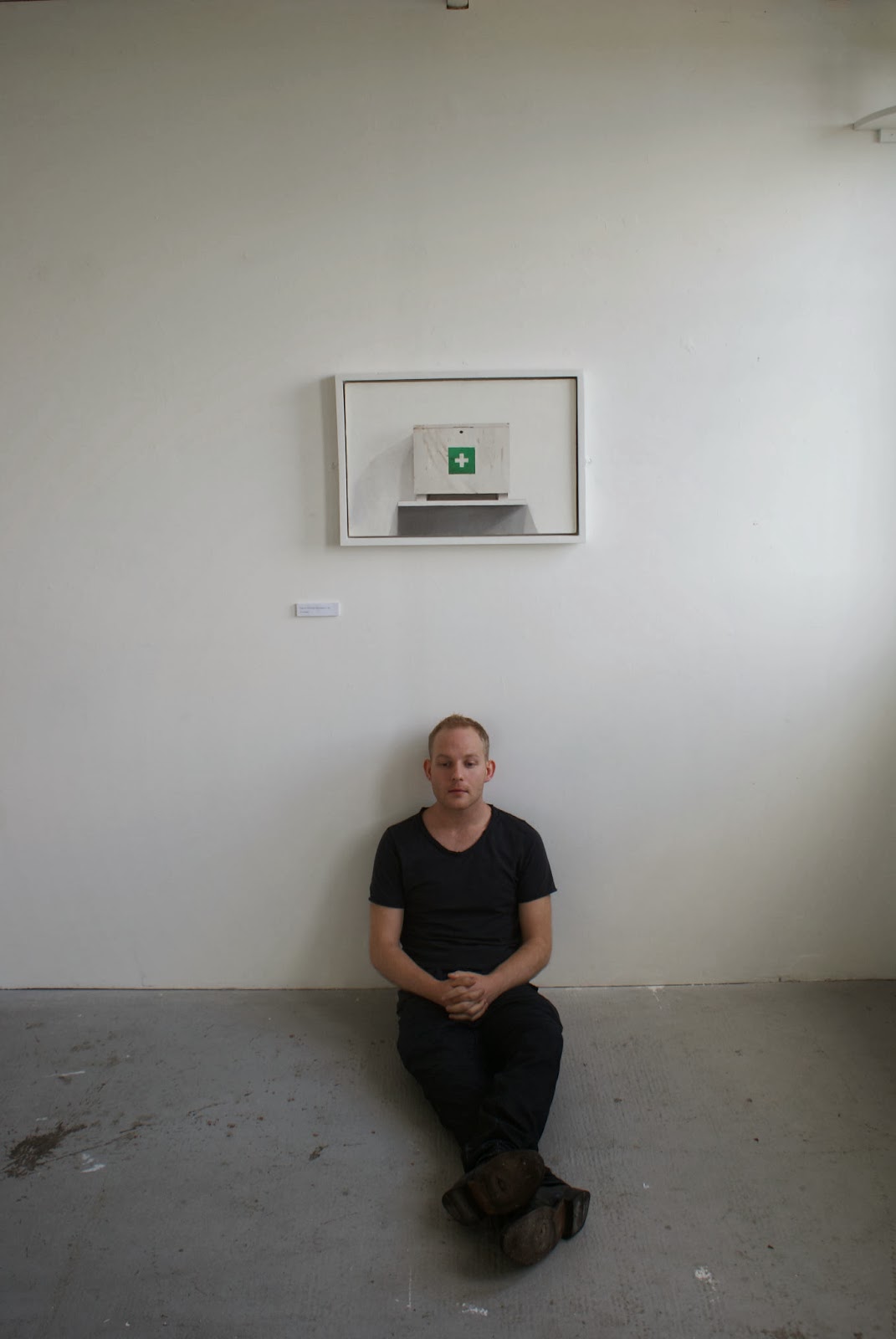
I recently took part in the Interview Room 11 'Paint Like you Mean It' painting exhibition its first biennial painting prize and exhibition which I was very pleased to take part in. The joint prize winners Mathew Pang (another ex-Grays student) and Edward Hill where announced today -well deserved. I've really enjoyed taking part in this event and was pleasantly surprised by the variety and quality of the other painters some of whom had come from as far as Germany and America. The show is on until the 14th in case anyone wants to check it out.

Click HERE to view a video about the event.

Here's some photos of the opening night:
 
You can just see my painting 'Elegy To Uncertainty' in the left corner of this photo.


That's mine again on the right (next to the winners painting by Edward Hill).


For more information about the event please feel free to visit the official PAINT LIKE YOU MEAN IT, by clicking HERE!

Also a list of the artists involved bellow:

Adam Kelly l Alice Walter l Angela Smith l Beau Rouse l Brian Cheeswright | Christy Yates l Cyrus Shroff l Daniel John l David McDiarmid l Edward Hill | Eilish McCann l Elizabeth Lyne l Enzo Marra l Gonzalo Reyes Araos | Graham Chorlton l Hannah Weatherhead l Henry Finney l Kate Livingstone | Liam Walker l Linn Sundqvist l Louisa Chambers l Marianne Morild | Matthew Pang l Michael Branthwaite l Mijung Koh l Molly Butt l Nishiki Tayui | Playpaint l Roy Immanuel l Russell Leng l Sally Taylor l Sooim Jeong


Wednesday, 19 February 2014

Red-faced


I recently attended The Hunterian Museum and Art Gallery’s ‘Allan Ramsay: Portraits of the Enlightenment’ exhibition symposium which as a whole was an extremely interesting event. One lecture that particularly caught my attention was one given by Rica Jones (conservator and historian of paintings) her lecture, titled ‘The significance of Ramsay's technique in context and perspective’ really captivated me -and I think anyone else interested in painting. 

Detailed bellow is some of Rica Jones’s insights in to Ramsay’s painting technique:


As a painter myself Rica’s lecture interested me because it discussed in great detail Ramsay’s portraiture painting technique. One thing I thought that really stood out to me was Ramsay’s use of under-painting for the face and skin tone of his sitters. He was known to make the initial underpainting in bright red mixed from ‘Vermilion’ and ‘Red Lake’ pigment a technique Ramsay learnt on his travels around France and Italy, the technique was at the time unknown in Britain. As a trained painter from art school this was something that curious to me, I’d always been taught that the best way to prepare a canvas was to create a tonal underpainting/first layer in Raw Umber (a kind of earthy brown colour) because Raw Umber was a neutral color that worked well with whatever subsequent layers would be paced upon it and this first layer would work well as a tonal guide helping you develop further layers towards the finish painting. The thought of using a colour other than Raw Umber for the initial underpainting foundation had simply never occurred to me.

After some internet research I couldn't find much on the subject of underpainting although I did stumble upon this blog with examples of underpainting and other painting techniques (It‘s well worth a read: http://underpaintings.blogspot.co.uk/2012/01/adrian-gottliebs-verdaccio-technique.html )! It was noticeable that the examples of underpainting featured in this blog are a mixture of Raw Umber and Lead White! The blog states that the Lead White base gives the finished painting a translucent effect gives a face its luminosity and is especially good for use against dark backgrounds (see the pictures bellow). Apparently Ramsay’s contemporary and rival Reynolds often painted face White then worked in while paint was still wet, although Reynolds technique was inconsistent.


 California-based artist Adrian Gottlieb demonstrates the 'verdaccio' technique (pictures above). 


As for information on Ramsay’s painting Rica highlighted one source the engraver and antiquarian George Vertue who writing in mid-1738 comments on Ramsay's technique saying;

Ramsay still accustoms him self to draw the face in red lines shades ect. Finishing the likeness in one red colour or mask before he puts on the flesh colour, which he proposes as a method to make the flesh clear & transparent – and such a method was used in Italy, by Cavaliere Luti & amp; others. So did Titian he says… however when the faces are painted 4. 5. Or six times over little or nothing of that first red is to be seen.

It's worth mentioning that in many ways 1740’s Britain lagged far behind the rest of Europe in terms of art and few painters in London had enjoyed an apprenticeship from an established painter, as a consequence there was no established technique for painting flesh tones of the face. Red facial underpainting is not a technique known to be used by any of Ramsay’s contemporaries in London, nor the Scottish painters whom would have inspired Ramsay in his youth in Edinburgh. Neither does it appear to have been used by Hans Hysing, a Swedish painter who Ramsay trained with in London 1732. As George Vertue points out however the underpainting is often painted over several times meaning that the underpainting is often only visible with aids such as high magnification, x-ray, or scientific analysis of paint and pigment. As Verture tells us, Ramsay came across the technique in Italy, though it is not known precisely from whom, Benedetto Luti, who Vertue mentions, would have been dead since 1724, though many of his pupils would have been working in Italy during Ramsay’s time. In this way Ramsay would have seen himself as allying his work with the great artists of Italy, living and dead.

When it comes to the red underpainting itself Rica Jones says that the face was often elaborately done with Vermillion and Red Lake, which were used mixed together and separately to produce a tonal likeness or 'flat red mask' in intense red tones. Once this red layer was completely dry the final tones containing significant amounts of black and green-earth pigments, to stop the final face appearing too ruddy, would be added. Oil paint becomes more translucent with time allowing this salmon coloured underpainting to show through a little more over time. Its likely that this delicate underpainting technique is what makes Ramsay stand apart from his contemporaries, its noticeable that Ramsey’s flesh tones compared to other portraits of the time often seem more warm and life-like, in comparison other portrait faces of the period often appear grey and pale like dead skin masks. I think ultimately it’s this style of painting that demonstrates Ramsay as a true innovator of his time and it’s his attention to technique and detail that stand testament to his dedication as a painter.

A portrait of William Hunter from the Hunterian museum permanent collection -note the warm skin tone of the face.


As for me, next time I paint this knowledge has given me the incentive to experiment with my underpainting and attempt to put some of Ramsay’s influence to use.


Notes: 
More information on the Ramsay exhibition can be found here.

I also used this exhibition catalogue 'Allan Ramsay: Portraits of the Enlightenment' from the Hunterian which features an essay by Rica Jones. 


Saturday, 18 January 2014

Happy New Year - 'Memorial' a 2012 exhibition of work by Christy Yates & Stephen Kavanagh.

Happy New Year!

 
-->
So its just turn 2014 and I’ve realised that I’ve not updated this blog in years. So my New Years resolution is to start updating this space more regularly.

In other news I just graduated in December from my Masters course in Museum Studies that I started in sebtember 2012. I thought a good way to start the New Years resolution would be to put up some photos from my last big art exhibition which I had just a month before moving to Glasgow to start my Masters course.

The exhibition statement and accompanying photos below are from me and Stephen Kavanagh's joint exhibition entitled ‘Memorial’ at Edinburgh’s London Road Art Complex on July 2012.


Memorial
An exhibition of work by Christy Yates and Stephen Kavanagh


Two up and coming recent graduates from Gray’s School of Art are set to open a two week exhibition entitled “Memorial” at the Arts Complex Galleries on London Road, Edinburgh.

This exhibition will showcase works by Christy Yates and Stephen Kavanagh. Two artists whose work thematically relates to concepts of memory and nostalgia in unique ways. Both work in meticulous fashion, producing highly detailed pieces reflecting their own experiences and ideas related to theses themes.

Christy deals with bizarre and singular objects such as left over scraps, newspapers, packaging bicker brack and rubbish whilst Stephen chooses to depict old and often derelict buildings, for instance; air raid shelters, linoleum factories and sunken theatre buildings. Both artists work deal heavily with the nostalgic, sentiment and historical feelings that people tend to place on inanimate objects. Buildings and items left in the wake of human inhabitancy if properly observed often have there own character or story to tell. What in some people’s eyes appears to be decrepit, broken and ruined junk to remain forgotten and disused to other peoples can be fragile treasures, monuments to the past, reminders acting as bookmarks to old stories. Both Stephen and Christy’s work understand the importance of these often understated items/spaces and try to celebrate them in a way that is fitting them but also to the artist’s own unique way of expression and observation.


The artists:

Stephen Kavanagh
Stephen’s ideas are translated into a series of sculptures and graphite drawings on paper. Working in a style that whilst remaining expressive and figurative, it gleams with a near machine like and industrial steely strength. The subject matter is brought together in a using drawing materials normally reserved for architectural and design purposes. Stephen often works tonally in shades of grey but uses his drawing implements in a way that brings a playful yet solemn character to the subject matter. In his drawings he uses rendering techniques that allows his depictions to be delicate but bold at the same time. His fascination lies within the collective memory and the human response to the built environment. “We are constantly in contact with the built environment, it would be impossible for these structures not to hold a past or a memory even if it is us who carry it for them.” 

Stephen Kavanagh has been working in Edinburgh for the past two years and has been involved in shows in Edinburgh, Aberdeen, Glasgow and London and was awarded the RSA John Kinross Scholarship in 2010.

Christy Yates
Christy’s work typically critiques the way in which modern art is displayed studing found objects which are often of a ‘disposable’ or ‘useless’ nature. Bringing his forms to life using white highlights and slight tonal variations bringing his subject matter to a solid conclusion. Christys’ paintings, often quiet and understated, with occasional flashes of bright colour designed to draw in the viewers eye. Working in the traditional medium of oil paint Christy creates a hard to achieve shading gradient that brings the paintings to an unintended ‘Photo-realistic’ finish, a three dimensional approach designed to show the sculptural qualities of the paintings subject matter.

 
So Long Lonesome
The Last Supper

Monument to Obsolescence

The three paintings below I did as a triptych.

Crowd Psychology
The Last Tiffany
Bernay's Torches of Freedom


 Here's some photos from the gallery space


My own personal statement and list of paintings


Twelve muses by: Christy Yates

“All the ancient writers appeal to the Muses at the beginning of their work. Homer asks the Muses both in the Iliad and Odyssey to help him tell the story in the most proper way, and until today the Muses are symbols of inspiration and artistic creation.
In painting the Muses are usually presented as ethereal women with divine beauty, holding laurels and other items depending on their faculty.”


The Ouroboros cycle

Miscellaneous Object Pt. III

Designed in California


Elegy to Uncertainty (Schrödinger's cat)

……………………………………………….

Black Man in the White House

………………………………………………..

Monument to Obsolescence


More than Meets the Eye

The Last Super

……………………………………………….

Crowd Psychology

Bernay’s Torches of Freedom

The Last Tiffany

……………………………………………….

So Long Lonesome


“In my work I examine the value of material objects and question the worth and Importance of what we choose to treasure and uphold in today’s society. Thus seeking to question what we may or may not perceive as a relic or object ‘worthy’ of sustained and serious artistic study and preservation.

My artistic practice primarily revolves around collecting objects of a mundane and ordinary nature. From a young age I have always horded and collected even the most obscure Items of bicker brack in a fashion that boarders on the obsessive compulsive.

Many of the Items I focus my attentions upon have a personal significance or narrative attached to them witch is hinted at, and reflected on in the painting titles. My objects and paintings often work as metaphors alluding to problems faced In daily life, as well as referencing elements of popular culture that have significantly Impacted upon myself.”

Thursday, 8 December 2011

Battenberg

“Squirrel motions for her to sit on one of the chairs.

Magpie chatters quizzically at the host and moves

apprehensively across the room”


The link above is for a Youtube trailer for Battenberg a short animation by a friend Stewart Comrie. I helped for a short time building the set and tinkering with some of the animation. Its won a few awards recently including a BAFTA for ‘Scotland New Talent Award 2010 for Best Animation’. Its about 13 minutes long and well worth checking out, think Aardman animations meets Jan Svankmajer.


Some photos i took from the set!


Tributes……….

· BAFTA Scotland New Talent Award 2010 for Best Animation

· Jim Poole Scottish Short Film Award Winner 2010,

· Nominated McLaren Award for Best New British Animation 201

· Edinburgh International Film 2010

· Inverness Film Festival 2010

· CFC Worldwide Short Film Festival 2010

· International Animated Film Festival 2010

· Encounters International Film Festival 2010

· Celluloid Screams Sheffield Horror Film Festival 2010

Just thinking over the exo i when to in London over a year ago now!

Kapoors sculptural installation ‘Hive’ is a huge hollowed out funnel shape made from rusted steel is the first thing to confront visitors at the main entrance. People walking through the front door are instantly greeted by two steel walls converging towards each until they meet in the centre, leaving a thin oval shaped hole. If you dare look through this orifice like gap you are given a tantalizing glimpse of what appears to be a huge unexplored steel abyss. A view the curators tells us evokes Courbet’s L’Origine du Monde, -the French painter’s daringly explicit and close-up landscape of a woman’s vulva.......


Hive - Anish Kapoor

Origin of the world - Gustave Courbet