Showing posts with label Art. Show all posts

Sunday, 1 March 2015

There and Back Again: Part III


-->
There and Back Again: Part III

My trip to:
Manchester/London/Florianopolis/Rio de Janeiro

In my last post I wrote about the exhibitions I visited whilst in Manchester for this entry I’m going to talk about my cultural sightseeing in Brazil between most of December and early January. Up for discussion will be the Museu Castro Maya.

Whist in Rio I visited the Museu de Arte do Rio (Rio Museum of Art) and Rio de Janeiro Botanical Garden, but my favorite cultural highlights by far was the Museu Castro Maya or the Castro Maya Museum (in English). Raymundo Ottoni de Castro Maya (1894-1968), or Castro Maya for short, was a buisness man and art collector  who was born in Paris and returned there several times, which made him a very familiar with European culture, and particularly the French.

Museum Plaque

It was his activity as a collector supporting national artistic values ​​and the pursuit of public access to it's collections that made ​​him a great patron committed to the city of Rio in which he lived. He helped create of the Company of the Hundred Bibliophiles of Brazil, in 1943, filling a cultural gap by editing 23 books, and Castro founded the Society for Friends of Printmaking in 1952, helped to spread the taste for engraving as artistic expression. It is also important to highlight that Castro had a pivotal role in the founding of the Museum of Modern Art in Rio de Janeiro in 1948, of which Castro was the first president.

The Castro Maya Museums - Museum of Sky Ranch in Santa Teresa, and Dam Museum, the Alto da Boa Vista - today constitute the set of museums belonging to the Brazilian Institute of Museums, Ministry of Culture. Based in Santa Teresa a neighborhood in the city of Rio de Janeiro located on top of the Santa Teresa hill. The area is famous for its winding, narrow streets a favorite spot for artists and tourists. The neighborhood originated around the Santa Teresa Convent, built in the 1750's on the Desterro hill. At the end of the 19th and early 20th century it was an upper class borough, as testified by its magnificent mansions, many of which are still standing. Santa Teresa has since ceased to be an upper-class neighborhood, but it has been recently revived as an artistic hotspot and is now home to several artists, art studios and galleries. Castro Maya, who lived in the neighborhood in his Chácara do Céu mansion which has now been turned into the Castro Maya Museum and its exhibits include works by Matisse, Jean Metzinger, Eliseu Visconti, Di Cavalcanti, and Candido Portinari it also includes some pretty smart period features.

Museum interior

Notice the painting Nature morte by Louis Casimir Marcoussis in the Museum Hallway

I truly loved the Castro Maya Museum not only does it boast a fantastic view from the hills looking over the city, but the yellow stone covering the facades and the exquisite art deco styled finishing’s make it worth checking out alone. Also the gardens that were designed by Roberto Burle Marx are beautiful and offer a very scenic view of downtown Rio.

 
Gardens were designed by Roberto Burle Marx

The view of downtown Rio

The Museum has a good selection of classical European art dating from the 1800's (Impressionists/expressionists ect) and Brazilian abstract art. The abstract art really caught my attention partly because Modernist Brazilian art was not something I was familiar with and there seemed to be some fascinating parallels with late Cubism/early Abstract Expressionism from America and Europe.

In Brazil abstract art as a movement came late in comparison to Europe. Brazil had a vigorous art scene, but it was one marked more by sturdy academic tradition. Even modern figurative art had to fight an arduous battle to impose itself upon the public during the 1920’s far behind what was going on in Europe and even the rest of South America. The Sao Paulo Biennial founded in 1951 (the second oldest art biennial in the world after the Venice Biennale) is commonly accepted as the landmark event that signaling the arrival abstract trends in Brazilian art. As a result of these changes on the national art scene the Castro Maya Museum from the 1950’s onwards started to expand its collection to the include more Abstract art. The epicenter of the Castro Maya collection is focused the years between the 1957 (IV) and 1959 (V) Biennials. As a result most of the works held by the Castro Maya Museum are composed during the second half of the 1950’s and the early 1960’s.

Untitled (1959) by Georges Mathieu

Untitled (1959) by Jean Paul Riopelle

Its noticeable that a lot of this work in the collection features modernist work and ideas that lean towards nationalist themes such as slums and are more influenced by Geometric Abstraction/Cubism. These works probably functioned as a kind of safe-conduct for acceptance, given how behind the rest of the Modernist world Brazil was even with a man like Castro Maya needed work that still had (no matter how vague) a connection to the figurative. Many of these Geometric/Cubist works Castro Maya could relate to more immediately because there modern features were still linked to reality and where a more obvious continuation of those more accepted earlier modernist European trends.

 
Untitled (1960) by Jean Guillaume

Untitled (1960) by Ivan Serpa

The abstract acquisitions at the end of the 1950’s are linked to the building of his home in the neighborhood of Santa Teresa. With its inauguration in 1958 the Chacara do Ceu was conceived as a white cube that would house the modern part of Maya’s Collection which was being vastly expanded at the time. Also while I was visiting the Museum had a show of contemporary art by Land Art and Installation artist Claudia Bakker showing the museum still has a role to play in the modern art world.

So yes, the Castro Maya Museum, very good!

Saturday, 31 January 2015

There and Back Again: Part I

 
-->


There and Back Again: Part I

My trip to:
Manchester/London/Florianopolis/Rio de Janeiro

I’ve been doing a lot of traveling throughout late November and December during this time I visited Manchester, London and spent Christmas in Brazil returning in early January. Thanks to these travels I got to see some fantastic museums and art galleries. So, I thought I’d start this year by doing a write-up about some of the cultural highlights I’ve seen in the last two months.

The key places I visited were Manchester Art Gallery, Manchester Museum Manchester Central Library, the National Football Museum and the Museum of Science and Industry, the Display Gallery, National Gallery in London and the Tate.
Whilst In Brazil I had a chance to see Museu de Arte do Rio (Rio Museum of Art), Rio de Janeiro Botanical Garden and Museus Castro Maya.

To be honest this late Christmas cultural review got a little bloated so I’ve decided to split it into three parts. Like what Peter Jackson did with his awful Hobbit blockbuster film trilogy… This first section will cover my highlights of Manchester the second post which features my trip to London I intend to have finished by February 18th and the third section covering my experiences in Brazil (fingers crossed) will be out at the very end of February or March 1st.


Manchester Art Gallery and The Sensory War 1914-2014
Manchester Art Gallery:
First off, I’d highly recommend Manchester Art Gallery it’s got some really good stuff on display I even got a take a sneaky look at Euan Uglow’s, The Quarry,  Pignano (1979) and Francis Bacon, Head VI (1948) two of my favorite painters which were in the middle of being taken down (I think they’d been left hanging from the recent ‘Radical Figures: Post-war British Figurative Painting’ exhibition that had just ended. I consider seeing these paintings an early Christmas treat.

Post-war artists aside Manchester Art Gallery has some great historic art collections especially it's Pre-Raphaelite paintings. There's also some good 18th Century art on display featuring classics' like Sir Joshua Reynolds and Thomas Gainsborough. From a curatorial stance the way the galleries are hung is quite interesting as well. In the historical galleries contemporary art pieces have been mixed in and juxtaposed against the more traditional work in a way that, for the most part, doesn’t feel forced or clichéd.

A good example of this curatorial philosophy in action is the positioning of their recent acquisition the Turner Prize-winning artist Grayson Perry’s work. The piece in question, titled Jane Austen in E17 (2009), is a beautifully executed large ceramic vase inspired in shape by Chinese porcelain, decorated with detailed drawings of elaborately dressed Georgian ladies taking tea and conversing. The genteel figures reflecting Perry’s interest in the feminine and his knowledge of historic dress. They refer to the ideal view of British culture portrayed in popular costume dramas of Jane Austen's novels. Grayson Perry’s work is notably surrounded by 18th Century and Early 19th portrait paintings featuring figures and personalities that could easily be straight of a Jane Austen costume drama.

Jane Austen in E17 (2009) by Grayson Perry

Elsewhere this modus operandi is continued in the exceptional 17th and 18th century Dutch and Flemish collection ‘Home, Land and Sea Art in the Netherlands 1600-1800’. In this gallery space there are over 50 Dutch and Flemish paintings from Manchester’s collection which includes exquisite paintings of everyday life, portraiture, landscapes, seascapes, and still life. A major part of the show is the juxtaposition of these Old Master paintings with contemporary work. On one wall the still lifes are mixed together in a salon-style hang with five modern day works key of which are Mat Collishaw’s Last Meal on Death Row, Texas series (2011), Gavin Turk’s two bronze painted gnawed apple cores Ergo Sum (2008) and artistic duo Rob and Nick Carter’s homage to Ambrosius Bosschaert Transforming Still Life Painting (2009-12).

Gallery space view, Dutch Masters mixed with Mat Collishaw and Rob/Nick Carter's work.

Gallery space view, Notice the wall to the left is hung label free in order to allow overall aesthetics to speak for themselves.
Rob and Nick Carter’s input is certainly the most attention grabbing of the contemporary art on display. Working with the Moving Picture Company the artistic duo replicated and animated Bosschaert’s flower painting currently hung in the Mauritshuis Museum in The Hague. The result is a three-hour film which was also three years in the making that animates Bosschaert’s original painting Vase with Flowers in a Window (1618). Watch closely for long enough and you can observe little insects fly in and out the frame, a snail working its way up the vase, flowers moving in the breeze and the light in the background gradually turns to dusk! It’s notable that this exhibition is co-curated by Philippa Stephenson the new Curator of European Art at Glasgow Museums.

These are actually painted bronze sculptures. Modern still lifes, these everyday, chewed apples made of bronze have been turned from the discarded into the treasured.

Massed Shipping Anchored in the Foreground: A View of Rotterdam Beyond (1706) by Jan Claesz. Rietschoof
Last Meal on Death Row, Texas (Paul Nuncio) (2011) by Matt Collishaw


The Sensory War 1914-2014:
Moving on from the permanent display galleries is Manchester Art Gallery art galleries big temporary exhibition at the moment entitled ‘The Sensory War 1914-2014’. This major group exhibition marking the Centenary of the First World War explores how artists have communicated the impact of military conflict on the body, mind, environment and human senses between 1914 and 2014. It brings together work from a range of leading artists including Henry Lamb, CRW Nevinson, Paul Nash, Otto Dix, Nancy Spero, Richard Mosse, Omer Fast and features works by the hibakusha (survivors of the atomic bomb dropped on Hiroshima) which were created in the 1970s and are being shown outside Japan for the first time. The exhibition is spread across two floors of the gallery and is divided into seven themes, each visceral in their focus and ideas: they take titles such as Bombing, Burning and Distant War and Chemical War and Toxic Imagination. Giving these themes substance and gravity are works like The Separation Line by artist Katie Davies, which documents the funeral processions through Royal Wootton Bassett in Wiltshire in the aftermath of the war in Afghanistan, and delicate drawings of disabled soldiers recovering in hospital by French artist Rosine Cahen.

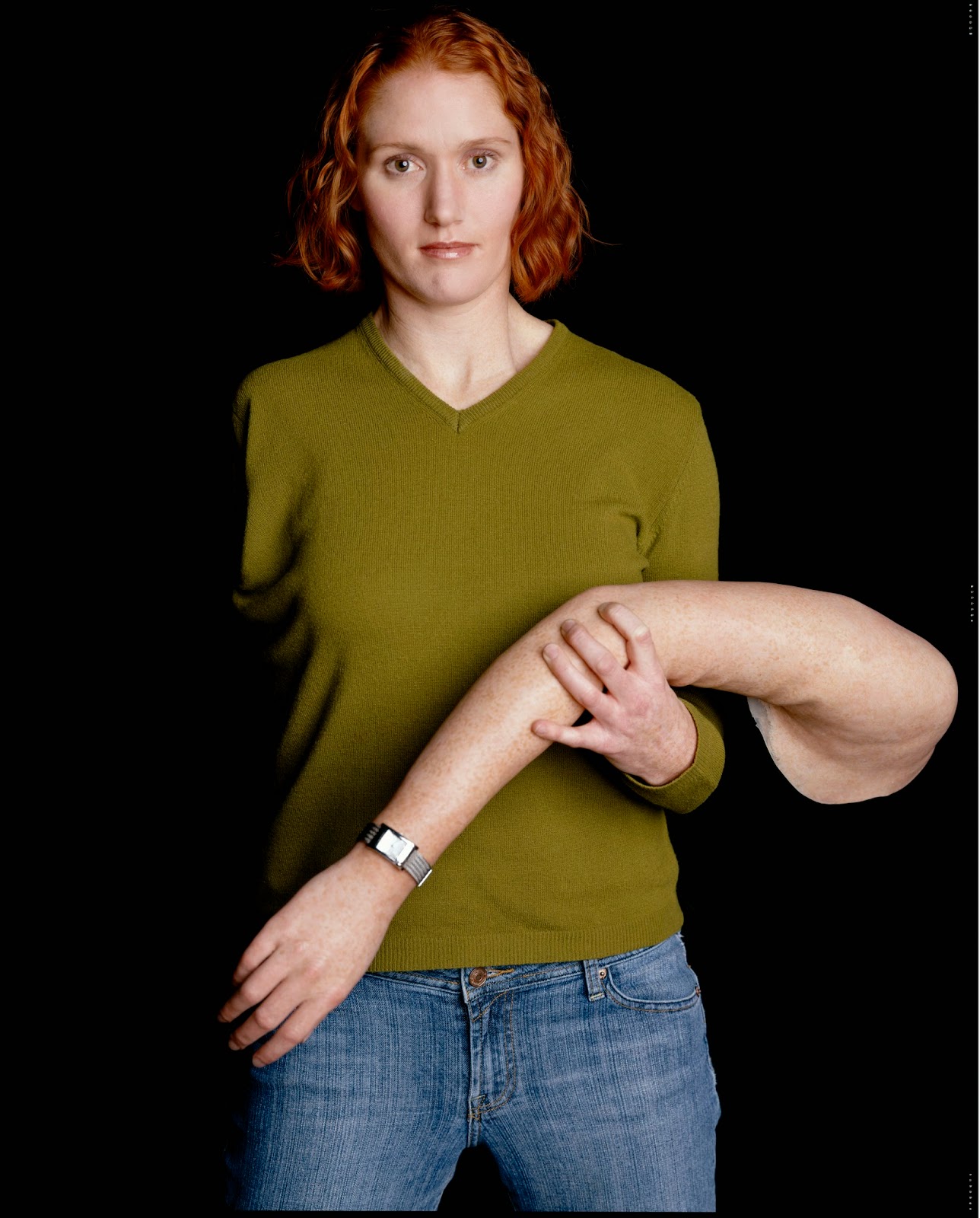
One work I found most haunting though was a picture by Nina Berman from the photographic series Marine Wedding that was first exhibited at the Whitney Biennial in 2010, and is considered an iconic work on the Iraq war. The wedding portrait featuring a Marine and his young bride is so harrowing because the uniformed serviceman Tyler Ziegel is disfigured beyond all recognition. A sense of foreboding extrudes from this print even before you learn that their marriage does not end well. The photograph is displayed amongst several other portraits of disabled veterans (another standout of which is Dawn Halfaker, 2006 by Timothy Greenfield-Sanders) and if nothing else demands a gut-wrenching response that you wont forget.

Marine Wedding (2010) by Nina Berman

Dawn Halfaker (2006) by Timothy Greenfield-Sanders

Elsewhere there are some old classics like the Paul Nash and the German Expressionist Otto Dix. I was really glad finally see some work by Paul Nash in the flesh. I’ve always liked his work and I think there has sometimes been a tendency to overlook his landscapes lumping him in with the other popular Surrealists of the same era. The Nash painting on display is Wounded at Passchendaele (1920) that depicts stretcher-bearers as they carry wounded through a poisonous Landscape filled with the bleak colours of gangrene and mustard gas.

Acetylene Welder (1917) by Christopher (C.R.W) Nevinson
There's was actually quite a few Nevinson paintings and drawings on display but it was his etchings I really loved! Just a little social context, those are female welders depicted in the picture above.

Other striking works amongst many at the show where the etching and drypoint Der Kreig - Sommschlact (Fleeing wounded Man, Battle of the Somme, 1916) by Otto Dix, some beautiful Lithographs by C.R.W Nevinson and Simon Norfolk's photograph of a destroyed Taliban Tank (2001-2) that appears to resemble the spine of an ancient carcass from some long extinct leviathan against a barren landscape. The picture has a surreal quality to which calls into mind the broken war-torn landscapes of the aforementioned Paul Nash to which Norfolk’s photography could almost be a modern riposte.

Track of destroyed Taliban tank at Farm Hada military base near Jalalabad (2001-02) by Simon Norfolk

Wounded at Passchendaele (1920) by Paul Nash


Manchester Museum:
After Manchester Art Gallery I visited the Manchester Museum which is the UK's largest university museum. The museums first collections were assembled by the Manchester Society of Natural History formed in 1821 with the purchase of John Leigh Philips natural history collection. Its well worth seeking out, its displays of Archaeology and Anthropology are fantastic and that’s before you get to Stan, a reproduction cast of a fossilised Tyrannosaurus rex acquired by the museum in 2004.  

Manchester Museum also boast live displays of species such snakes and exotic frogs the spice things up as well. I was particularly gripped by how the museum displayed its collections. In some sections the illuminated Wunderkammer like cabinets of curiosities are separated into various lose themes such as: ‘Experience’, ‘Right wildlife’, ‘Disasters’ and ‘Resources’. For instance the Resources section has old taxidermied animals scrabbling humorously for natural resources. 

The Experience display case.
Experience display case, two close-ups (above)
Inside the Experience display case: A preserved Snake & Octopus specimens.
Manchester Museum has live snakes and other animals too!
Funnily enough at the time of my visit the Disasters section was ironically cordoned of for 
repair work.


(Above) The Disasters section was apparently cordoned off.
(Left) A taxidermied bird of pray in the Resources section display case.

Manchester also has huge amount of Egyptology stuff the size of their Egyptology display is something that could put some well funded National Gallery collections to shame. Because it’s a university museum the displays here are only essentially the public face of the cutting edge research going on behind the scenes. I’ve been curious about the Egyptology department in Manchester ever since June 2013. This is because at this time I read that an Egyptian mummy from my own local Perth Museum and Art Gallery in Scotland was transported to The University of Manchester for investigation by members of the KNH Centre for Biomedical Egyptology’s Bio Bank team. The resulting investigation made worldwide headlines.

Me with Stan the T-Rex.
So in short, if you go Manchester Museum and ONLY want to see dinosaurs and Egyptian stuff, it would be worth it just for that!


And finally....
Other attractions I visited in Manchester but don’t have time to discuss in this blog are Manchester Central Library that’s just had a amazing refurbishment, the National Football Museum and the Museum of Science and Industry. Worth mentioning -I have absolutely no interest in football but the recently completed National Football Museum is a masterpiece of modern day interactive exhibition design which worked to such effect that even I couldn’t help but get carried away and enthralled by some of the interactive display!


My next post in two weeks time on the 15th of February will be discussing Turner at the Tate, The Display Gallery, Peder Balke and Rembrandts Late Works at the National Gallery of London.


Christy


P.s
I case no one got the Blog title, I read J.R.R Tolkien's The Hobbit over Christmas while I was traveling!

Monday, 1 December 2014

The New English Art Club

The New English Art Club & Charitable Trust Award!

I'm pleased to announce that I have two painting's on display at this years New English Art Club annual open exhibition at the Mall Galleries in London. Adding to my jubilation at having work accepted for the event I was also awarded The Arts Charitable Trust Award in association with The Arts Club Award which is worth £1,000. The award was split between me and fellow artist Eigil Nordstrom, this is the first time I've shown artwork outside Scotland.

I was awarded the prize by David Mellor, ex Cabinet Minister and Secretary of State in the Department for National Heritage at the Mall Galleries opening night on 27th of November.

Here's a couple of snaps from the event:

Me with certificate.

 Me & my painting.                      Me being presented the award.

 WINNING!

 Cowboy Killers...


Oh, here's the two award winning paintings in question!

 Elegy to Uncertainty (Schrodinger's cat)

 Black Man In The White House


And for fun here's a scan of the certificate and event invite!


The show runs untill the 8th of December for more Information on The New English Art Club and the Art Club Charitable Trust Award check out the links bellow:

New English Art Club Prizes 2014
Mall Galleries
About The New English Art Club


Sunday, 13 July 2014

La Galerie 1940

 
-->
La Galerie 1940


Art update!: I'm presenting some artwork for a group exhibition this weekend in Edinburgh at La Galerie 1940 on Melville Terrace, Edinburgh It's a new contemporary art gallery located at the Meadows around the corner from Summerhall the former Royal School of Veterinary Studies in Edinburgh now a creative hub for the arts. Its been a really exciting opportunity for me as it’s the first time I’ve had a chance to show my work in a commercial gallery (before its always been open exhibition competitions, pubs or artist let collectives) and represents an opportunity for me to dip my toes into something a little new!

La Galerie 1940 is a really interesting art space as well and is only in its first month of opening. Whilst whishing to function as a commercial gallery the owners seem to want to showcase young up and coming talent. La Galerie 1940 is also interested in artists from different disciplines, including sculpture, ceramics, glass, jewellery and even performance art.

The show runs until the 27th of July.
Here's some picture's from the opening night:


On the right, Jenny Mason who was also showing work in the gallery!


Here's a little video promo: Click here to view it on Vimeo.
Click here to view a link to La Galerie 1940’s website, http://www.lagalerie1940.co.uk/


Other artists currently exhibiting at La Galerie are: Jenny Mason, Alex Spencer, Sian Patterson, Avril Scott, Monika Grabowska, Mariola Albinowska, Liv Wan, Sencha, Tiina Lilja, Magdalena Zbrozek, Stephen Kavanagh and Loff.

Saturday, 18 January 2014

Happy New Year - 'Memorial' a 2012 exhibition of work by Christy Yates & Stephen Kavanagh.

Happy New Year!

 
-->
So its just turn 2014 and I’ve realised that I’ve not updated this blog in years. So my New Years resolution is to start updating this space more regularly.

In other news I just graduated in December from my Masters course in Museum Studies that I started in sebtember 2012. I thought a good way to start the New Years resolution would be to put up some photos from my last big art exhibition which I had just a month before moving to Glasgow to start my Masters course.

The exhibition statement and accompanying photos below are from me and Stephen Kavanagh's joint exhibition entitled ‘Memorial’ at Edinburgh’s London Road Art Complex on July 2012.


Memorial
An exhibition of work by Christy Yates and Stephen Kavanagh


Two up and coming recent graduates from Gray’s School of Art are set to open a two week exhibition entitled “Memorial” at the Arts Complex Galleries on London Road, Edinburgh.

This exhibition will showcase works by Christy Yates and Stephen Kavanagh. Two artists whose work thematically relates to concepts of memory and nostalgia in unique ways. Both work in meticulous fashion, producing highly detailed pieces reflecting their own experiences and ideas related to theses themes.

Christy deals with bizarre and singular objects such as left over scraps, newspapers, packaging bicker brack and rubbish whilst Stephen chooses to depict old and often derelict buildings, for instance; air raid shelters, linoleum factories and sunken theatre buildings. Both artists work deal heavily with the nostalgic, sentiment and historical feelings that people tend to place on inanimate objects. Buildings and items left in the wake of human inhabitancy if properly observed often have there own character or story to tell. What in some people’s eyes appears to be decrepit, broken and ruined junk to remain forgotten and disused to other peoples can be fragile treasures, monuments to the past, reminders acting as bookmarks to old stories. Both Stephen and Christy’s work understand the importance of these often understated items/spaces and try to celebrate them in a way that is fitting them but also to the artist’s own unique way of expression and observation.


The artists:

Stephen Kavanagh
Stephen’s ideas are translated into a series of sculptures and graphite drawings on paper. Working in a style that whilst remaining expressive and figurative, it gleams with a near machine like and industrial steely strength. The subject matter is brought together in a using drawing materials normally reserved for architectural and design purposes. Stephen often works tonally in shades of grey but uses his drawing implements in a way that brings a playful yet solemn character to the subject matter. In his drawings he uses rendering techniques that allows his depictions to be delicate but bold at the same time. His fascination lies within the collective memory and the human response to the built environment. “We are constantly in contact with the built environment, it would be impossible for these structures not to hold a past or a memory even if it is us who carry it for them.” 

Stephen Kavanagh has been working in Edinburgh for the past two years and has been involved in shows in Edinburgh, Aberdeen, Glasgow and London and was awarded the RSA John Kinross Scholarship in 2010.

Christy Yates
Christy’s work typically critiques the way in which modern art is displayed studing found objects which are often of a ‘disposable’ or ‘useless’ nature. Bringing his forms to life using white highlights and slight tonal variations bringing his subject matter to a solid conclusion. Christys’ paintings, often quiet and understated, with occasional flashes of bright colour designed to draw in the viewers eye. Working in the traditional medium of oil paint Christy creates a hard to achieve shading gradient that brings the paintings to an unintended ‘Photo-realistic’ finish, a three dimensional approach designed to show the sculptural qualities of the paintings subject matter.

 
So Long Lonesome
The Last Supper

Monument to Obsolescence

The three paintings below I did as a triptych.

Crowd Psychology
The Last Tiffany
Bernay's Torches of Freedom


 Here's some photos from the gallery space


My own personal statement and list of paintings


Twelve muses by: Christy Yates

“All the ancient writers appeal to the Muses at the beginning of their work. Homer asks the Muses both in the Iliad and Odyssey to help him tell the story in the most proper way, and until today the Muses are symbols of inspiration and artistic creation.
In painting the Muses are usually presented as ethereal women with divine beauty, holding laurels and other items depending on their faculty.”


The Ouroboros cycle

Miscellaneous Object Pt. III

Designed in California


Elegy to Uncertainty (Schrödinger's cat)

……………………………………………….

Black Man in the White House

………………………………………………..

Monument to Obsolescence


More than Meets the Eye

The Last Super

……………………………………………….

Crowd Psychology

Bernay’s Torches of Freedom

The Last Tiffany

……………………………………………….

So Long Lonesome


“In my work I examine the value of material objects and question the worth and Importance of what we choose to treasure and uphold in today’s society. Thus seeking to question what we may or may not perceive as a relic or object ‘worthy’ of sustained and serious artistic study and preservation.

My artistic practice primarily revolves around collecting objects of a mundane and ordinary nature. From a young age I have always horded and collected even the most obscure Items of bicker brack in a fashion that boarders on the obsessive compulsive.

Many of the Items I focus my attentions upon have a personal significance or narrative attached to them witch is hinted at, and reflected on in the painting titles. My objects and paintings often work as metaphors alluding to problems faced In daily life, as well as referencing elements of popular culture that have significantly Impacted upon myself.”