Sunday, 15 February 2015

There and Back Again: Part II


-->
There and Back Again: Part II

My trip to:
Manchester/London/Florianopolis/Rio de Janeiro

In my last post I wrote about the museums and galleries I visited whilst in Manchester for this entry I’m going to talk about my cultural sightseeing in London on the 7th of December. Up for discussion will be the Display Gallery, National Gallery in London and the Tate.

In this post I'll be discussing the exhibitions: 'Late Turner', 'Peder Balke' and 'Rembrandt: The Late Works'.
In two weeks time in Part III I’ll be discussing Brazil and the Museu de Arte do Rio (Rio Museum of Art), Rio de Janeiro Botanical Garden and Museus Castro Maya.

Tate Britain
The EY Exhibition: Late Turner – Painting Set Free
The EY Exhibition: Late Turner – Painting Set Free is the first exhibition devoted to the extraordinary work J.M.W. Turner created between 1835 and his death in 1851. Bringing together spectacular works from the UK and abroad, this exhibition celebrates Turner’s astonishing creative flowering in these later years. It's during this period he produced many of his finest pictures but was also controversial and unjustly misunderstood at the time. In his later work Tuner started to experiment with his technique further stepping away from the established rules of the dominant Romantic and Neoclassical traditions of this era. It’s this style that is said to have become influential to Monet to Matisse, who learned from Turner how colour could be expressive, atmospheric, even abstract. This causes many to argue that Turner is then the father of modern art.

I’ve always loved Turner I think he’s the greatest British artist of his era, if not the greatest British artist ever. So this collection of his later work on display at the Tate - just in time for the new 'Oscar bait' biopic movie was a must see for me.

 
If anything the exhibition is huge and there's a lot of diversity among Turners later works. This exhibition is notable for even displaying unfinished canvases taken from his studio after his death. It’s left to the viewer to decide whether these painting truly represent Turner. To be honest I think Turner had hits and misses at every period in his career and everything here is on show. But there is enough classic masterpieces on display to keep even the most critical eye at bay –the only big exception being The Slave Ship, originally entitled Slavers Throwing overboard the Dead and Dying—Typhon coming on (1840).

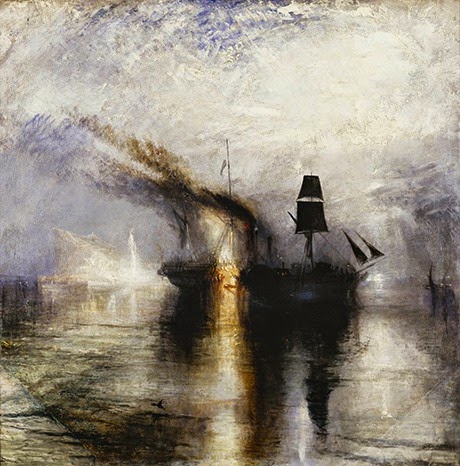
Some of the classics on display are Rain, Steam and Speed (1844) with the Philadelphia Museum’s The Burning of the Houses of Lords and Commons (1834), Burial at Sea (1842) and Snow Storm - Steam-Boat off a Harbour’s Mouth (1842).

Rain, Steam and Speed (1844)
Burial at Sea (1842)
Snow Storm - Steam-Boat off a Harbour’s Mouth (1842)

Late Turner: Painting Set Free as well as unfinished also exhibits watercolours and sketchbooks. So in short, any painting geek who really wants to get under the skin of JWM Turner has every opportunity in this show.


Peder Balke at the National Gallery

I don’t know why but I’ve always been a sucker for Scandinavian stuff whether it be my love of Tove Jansson’s Moomins and her sparsely written adult fiction, Vikings and Norse mythology, my fascination with Nowlegien Black Metal and the Gothenburg melodic death metal scene, the recent RSA travel awards depictions of Antarctica by Frances Walker, the vonlenska folk styled falsettos of Icelandic post-rock group Sigur Rós, to the modern gothic Frankenstein esc classic ghost story set in Svalbard written by Michelle Paver ‘Dark Matter’. Generally culture from that part of the world tends to draw my attention. I don’t know why -maybe it’s my northern roots showing themselves. Either way the Norwegian artist Peder Balke, whom I hadn’t heard of until recently really caught my eye. In defense of my ignorance I don’t think he particularly well known outside his own country. 
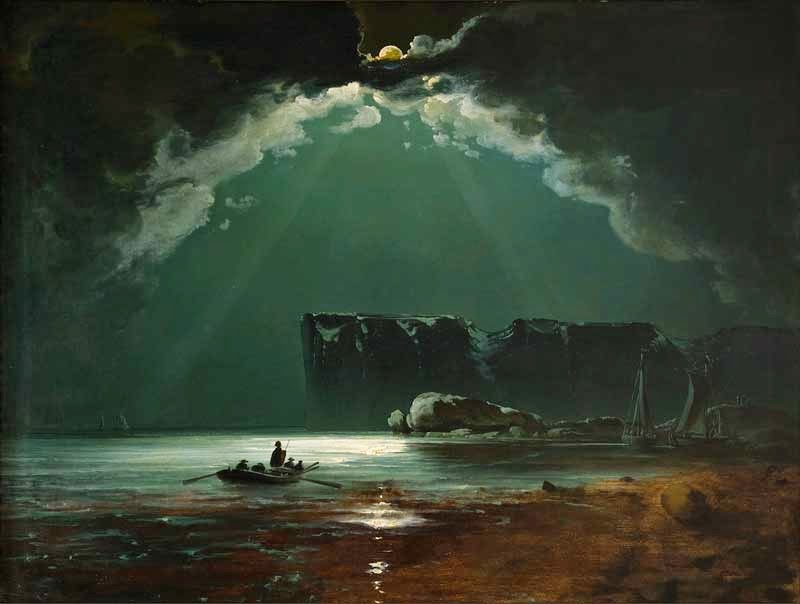
North Cape (probably 1840s) by Peder Balke
Peder Balke (1804-1887) is one of the most innovative and original artists at the moment the Romantic era gave way to the Modern. In order to depict the sublime landscapes of his native Norway, he invented a highly experimental technique. For this, he was greatly criticized during his lifetime, and eventually forgotten. In retrospect being shunned by the elite for starting to develop your own experimental style is something of an artistic badge of honor.

The Trolltindene Range (1845) by Peder Balke
By 1832, the 28-year-old Peder Balke was already noted for his indefatigable walking tours of Southern Norway in search of landscape motifs. That year his horizons expanded as a ship carried him due north along the rugged coast high above the Arctic Circle, beyond the North Cape to the border of Russia. It was further than any Norwegian artist before him had traveled for his art. Balke repeatedly returns to a few landscape motifs like the Northern Cape and he usually relies on a surprisingly simple compositional formulae; for the most part, his pictures consist of horizontal strata rising up the picture plane one atop another to represent various combinations of sea, shore, cliff, mountain ranges and sky. In some pictures the horizontal strata are intersected by a single, resonant vertical – a lighthouse or a jagged peak – charged with symbolic import. Depiction of given motif slowly became for Balke a forum for experimentation with colour, light effects and paint-handling techniques.

Balke’s earlier works executed between the 1840’s and 1850’s are very competent Scandinavian landscapes what really got my inner painter excited was his 1860’s onwards work. The depicted landscapes become whiter, starker and more minimalistic with cold seascapes and epic mountain ranges. This bleaker subject matter is also mirrored in his painting style which becomes more impressionist and the canvases less ‘finished’. Paint has often been rubbed back leaving nothing behind but the white ground primer layer and often exposing the texture of the wooden board beneath. It’s a painting technique that seems to become Balke’s signature style.

Mount Stetind in Fog (1864) by Peder Balke
 
North Cape (1860s) by Peder Balke

One of many 'North Cape's (pictured above) this is representative of his process. Here, thinned washes of paint flow across the ground prime layer until, it seems, they draw fourth the scene inherent in the flow of the medium.
Sun Breaking Through Clouds at Vardøhus by Peder Balke

Some of the bleak expressionism qualities of Balke's work bring to mind The Scream fellow Norwigian artist Edvard Munch. I can't help wondering if there isn't a little influence.


Rembrandt: The Late Works - National Gallery


This exhibition really knocked me of my feet. I know that’s what all these blockbuster style exhibitions promotions promise, but it’s the first time in awhile that one of theses high profile shows has really blown me away! Obviously I’m familiar with Rembrandt and his later works. For the uninitiated basically during his later days Rembrandt’s painting style became more expressive - much to the horror of the established art elite at the time - and his works became much less fancifully, more expressive and more personally introspective. Rembrandt had always been an incredible painter but it this surprise burst of creativity and experimentation so late in his career that’s really cemented his position as one of histories greats. Not unlike Turner (and Balke) its this later more expressive style that present day art historians now recognize as one of Modern Arts early milestones giving birth to Impressionism and the likes.

Self-Portrait (1669) at the Age of 63
Seeing so many Rembrandt’s in one place is truly a humbling experience. To my eye what makes his portraits really stand out is that they seem almost sculpted rather than painted due to his use of tone and Illuminance high-lights, the faces really seem to bulge right out of the canvases. Its worth noting that this exhibition is really well hung the walls are colored a murky dark grey/mauve the ambient room lighting is dim with each individual frame is lit via focused spotlights. This has the over-all effect of really causing the faces to burst out the frames emerging from the dusky shadows. The gallery lighting also really helps the golden jewelry. I’d never quite appreciated how the decorative gold ornaments on Rembrandts sitters really do glisten, and again this effect is aided by the gallery spotlights. The sitters are often dressed up in all the pomp you expect from seventeenth century aristocratic Dutch merchants and if anything Rembrandt proves himself as the painter of gold and light. The ornate jewelry isn’t necessarily painted in fine detail but in thick swabs and chunks of oil paint the overall effect means the glistening highlights almost look like liquid mercury dripping over the sitters –a painting effect aided by the darkened gallery space and powerful lighting arrangements. It’s worth mentioning that a small downside of this hanging arrangement is that it causes some of the higher hung larger paintings to reflect the spotlights off the glossy painting surface making them hard to view from certain angles. Whilst talking about the way Rembrandt thickly applies gold its worth mentioning that he has a tendency of thickly applying paint to the bulbous features of his sitters faces this makes the noses and wrinkles really stand out. It’s these textural details that I think give his portraits their more sculptural qualities. Not to say Rembrandt is all about thick textures, highlights and dark tones. Where it really counts Rembrandt knows how to deftly niggle out fine details around eyes and lips and draw you (the viewer) in. Its a display of pure draftsmanship and its this majesty that really gives Rembrandt’s paintings a dramatic punch.

Some of the works seem to possess an Illuminant golden glow of their own
 in the gallery space.


Thematically the paintings in ‘The Late Works’ are separated through seven rooms and each rooms paintings are hung in series by a theme. For instance Room One ‘Self-Scrutiny; Rembrandt considers the his own ageing features’ contains several different Rembrandt self portraits spanning two decades of the later period, where-as Room Four holds ‘Artistic Conventions; Rembrandt brings new energy to traditional painting formats’ this room contains a series of paintings where Rembrandt pushes the boundaries of traditional approaches to iconography and portraiture with his own vision. For instance in the portrait of Margaretha de Geer wife of Jacob Trip Rembrandt honored the advancing age of the wealthy Dordrecht merchant and his wife by using what resembles a delicate, almost Impressionistic touch to expresses their physical frailty. 

I quite like this thematic hanging arrangement, as apposed to say a chromatic hanging arrangement. This way you get to see how old Rembrandt develops a single theme over the course of several decades this for instance being most obvious in depictions of himself.

I also had a little moment of civic pride seeing a painting normally kept in Glasgow's own Kelvingrove Museum. A Man in Armour (1655) was hung in Room Six 'Contemplation' and really stood out as one of the best paintings in that particular section (see image bellow)!

Harmenszoon van Rijn, A Man in Armour (1655)

Lucretia (1664)

Self Portrait (1658) (Frick Collection)
Seriously though look at the gold, these photo's don't do the paintings justice. Rembrandt’s, like the king of bling! 

The Conspiracy of the Batavians under Claudius Civilis' (1661-62) (cut-down)
The exhibition also includes The Conspiracy of the Batavians under Claudius Civilis' (1661-62), originally Rembrandt’s largest and most prestigious painting. Owned by the Royal Swedish Academy of Fine Arts, the painting has been at the National museum of Art in Stockholm for more than 150 years, leaving Sweden only twice in that time, in 1925 and 1969. Both of those occasions were for showings at the Rijksmuseum. So, this very famous painting is basically one of the many reasons why this exhibition is very special.

Summing up, this a fantastic exhibition well worth seeing! 

Christy

Saturday, 31 January 2015

There and Back Again: Part I

 
-->


There and Back Again: Part I

My trip to:
Manchester/London/Florianopolis/Rio de Janeiro

I’ve been doing a lot of traveling throughout late November and December during this time I visited Manchester, London and spent Christmas in Brazil returning in early January. Thanks to these travels I got to see some fantastic museums and art galleries. So, I thought I’d start this year by doing a write-up about some of the cultural highlights I’ve seen in the last two months.

The key places I visited were Manchester Art Gallery, Manchester Museum Manchester Central Library, the National Football Museum and the Museum of Science and Industry, the Display Gallery, National Gallery in London and the Tate.
Whilst In Brazil I had a chance to see Museu de Arte do Rio (Rio Museum of Art), Rio de Janeiro Botanical Garden and Museus Castro Maya.

To be honest this late Christmas cultural review got a little bloated so I’ve decided to split it into three parts. Like what Peter Jackson did with his awful Hobbit blockbuster film trilogy… This first section will cover my highlights of Manchester the second post which features my trip to London I intend to have finished by February 18th and the third section covering my experiences in Brazil (fingers crossed) will be out at the very end of February or March 1st.


Manchester Art Gallery and The Sensory War 1914-2014
Manchester Art Gallery:
First off, I’d highly recommend Manchester Art Gallery it’s got some really good stuff on display I even got a take a sneaky look at Euan Uglow’s, The Quarry,  Pignano (1979) and Francis Bacon, Head VI (1948) two of my favorite painters which were in the middle of being taken down (I think they’d been left hanging from the recent ‘Radical Figures: Post-war British Figurative Painting’ exhibition that had just ended. I consider seeing these paintings an early Christmas treat.

Post-war artists aside Manchester Art Gallery has some great historic art collections especially it's Pre-Raphaelite paintings. There's also some good 18th Century art on display featuring classics' like Sir Joshua Reynolds and Thomas Gainsborough. From a curatorial stance the way the galleries are hung is quite interesting as well. In the historical galleries contemporary art pieces have been mixed in and juxtaposed against the more traditional work in a way that, for the most part, doesn’t feel forced or clichéd.

A good example of this curatorial philosophy in action is the positioning of their recent acquisition the Turner Prize-winning artist Grayson Perry’s work. The piece in question, titled Jane Austen in E17 (2009), is a beautifully executed large ceramic vase inspired in shape by Chinese porcelain, decorated with detailed drawings of elaborately dressed Georgian ladies taking tea and conversing. The genteel figures reflecting Perry’s interest in the feminine and his knowledge of historic dress. They refer to the ideal view of British culture portrayed in popular costume dramas of Jane Austen's novels. Grayson Perry’s work is notably surrounded by 18th Century and Early 19th portrait paintings featuring figures and personalities that could easily be straight of a Jane Austen costume drama.

Jane Austen in E17 (2009) by Grayson Perry

Elsewhere this modus operandi is continued in the exceptional 17th and 18th century Dutch and Flemish collection ‘Home, Land and Sea Art in the Netherlands 1600-1800’. In this gallery space there are over 50 Dutch and Flemish paintings from Manchester’s collection which includes exquisite paintings of everyday life, portraiture, landscapes, seascapes, and still life. A major part of the show is the juxtaposition of these Old Master paintings with contemporary work. On one wall the still lifes are mixed together in a salon-style hang with five modern day works key of which are Mat Collishaw’s Last Meal on Death Row, Texas series (2011), Gavin Turk’s two bronze painted gnawed apple cores Ergo Sum (2008) and artistic duo Rob and Nick Carter’s homage to Ambrosius Bosschaert Transforming Still Life Painting (2009-12).

Gallery space view, Dutch Masters mixed with Mat Collishaw and Rob/Nick Carter's work.

Gallery space view, Notice the wall to the left is hung label free in order to allow overall aesthetics to speak for themselves.
Rob and Nick Carter’s input is certainly the most attention grabbing of the contemporary art on display. Working with the Moving Picture Company the artistic duo replicated and animated Bosschaert’s flower painting currently hung in the Mauritshuis Museum in The Hague. The result is a three-hour film which was also three years in the making that animates Bosschaert’s original painting Vase with Flowers in a Window (1618). Watch closely for long enough and you can observe little insects fly in and out the frame, a snail working its way up the vase, flowers moving in the breeze and the light in the background gradually turns to dusk! It’s notable that this exhibition is co-curated by Philippa Stephenson the new Curator of European Art at Glasgow Museums.

These are actually painted bronze sculptures. Modern still lifes, these everyday, chewed apples made of bronze have been turned from the discarded into the treasured.

Massed Shipping Anchored in the Foreground: A View of Rotterdam Beyond (1706) by Jan Claesz. Rietschoof
Last Meal on Death Row, Texas (Paul Nuncio) (2011) by Matt Collishaw


The Sensory War 1914-2014:
Moving on from the permanent display galleries is Manchester Art Gallery art galleries big temporary exhibition at the moment entitled ‘The Sensory War 1914-2014’. This major group exhibition marking the Centenary of the First World War explores how artists have communicated the impact of military conflict on the body, mind, environment and human senses between 1914 and 2014. It brings together work from a range of leading artists including Henry Lamb, CRW Nevinson, Paul Nash, Otto Dix, Nancy Spero, Richard Mosse, Omer Fast and features works by the hibakusha (survivors of the atomic bomb dropped on Hiroshima) which were created in the 1970s and are being shown outside Japan for the first time. The exhibition is spread across two floors of the gallery and is divided into seven themes, each visceral in their focus and ideas: they take titles such as Bombing, Burning and Distant War and Chemical War and Toxic Imagination. Giving these themes substance and gravity are works like The Separation Line by artist Katie Davies, which documents the funeral processions through Royal Wootton Bassett in Wiltshire in the aftermath of the war in Afghanistan, and delicate drawings of disabled soldiers recovering in hospital by French artist Rosine Cahen.

One work I found most haunting though was a picture by Nina Berman from the photographic series Marine Wedding that was first exhibited at the Whitney Biennial in 2010, and is considered an iconic work on the Iraq war. The wedding portrait featuring a Marine and his young bride is so harrowing because the uniformed serviceman Tyler Ziegel is disfigured beyond all recognition. A sense of foreboding extrudes from this print even before you learn that their marriage does not end well. The photograph is displayed amongst several other portraits of disabled veterans (another standout of which is Dawn Halfaker, 2006 by Timothy Greenfield-Sanders) and if nothing else demands a gut-wrenching response that you wont forget.

Marine Wedding (2010) by Nina Berman

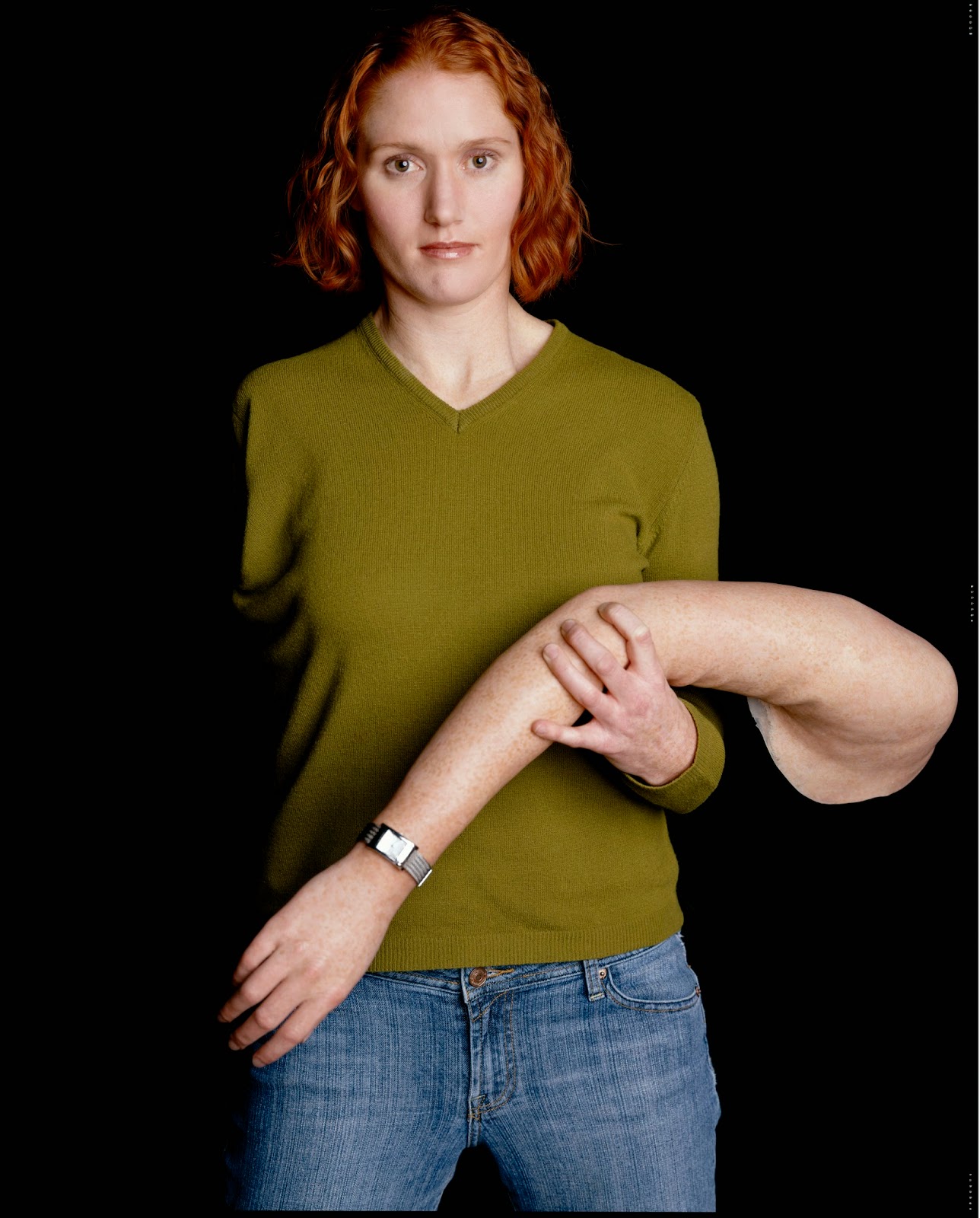
Dawn Halfaker (2006) by Timothy Greenfield-Sanders

Elsewhere there are some old classics like the Paul Nash and the German Expressionist Otto Dix. I was really glad finally see some work by Paul Nash in the flesh. I’ve always liked his work and I think there has sometimes been a tendency to overlook his landscapes lumping him in with the other popular Surrealists of the same era. The Nash painting on display is Wounded at Passchendaele (1920) that depicts stretcher-bearers as they carry wounded through a poisonous Landscape filled with the bleak colours of gangrene and mustard gas.

Acetylene Welder (1917) by Christopher (C.R.W) Nevinson
There's was actually quite a few Nevinson paintings and drawings on display but it was his etchings I really loved! Just a little social context, those are female welders depicted in the picture above.

Other striking works amongst many at the show where the etching and drypoint Der Kreig - Sommschlact (Fleeing wounded Man, Battle of the Somme, 1916) by Otto Dix, some beautiful Lithographs by C.R.W Nevinson and Simon Norfolk's photograph of a destroyed Taliban Tank (2001-2) that appears to resemble the spine of an ancient carcass from some long extinct leviathan against a barren landscape. The picture has a surreal quality to which calls into mind the broken war-torn landscapes of the aforementioned Paul Nash to which Norfolk’s photography could almost be a modern riposte.

Track of destroyed Taliban tank at Farm Hada military base near Jalalabad (2001-02) by Simon Norfolk

Wounded at Passchendaele (1920) by Paul Nash


Manchester Museum:
After Manchester Art Gallery I visited the Manchester Museum which is the UK's largest university museum. The museums first collections were assembled by the Manchester Society of Natural History formed in 1821 with the purchase of John Leigh Philips natural history collection. Its well worth seeking out, its displays of Archaeology and Anthropology are fantastic and that’s before you get to Stan, a reproduction cast of a fossilised Tyrannosaurus rex acquired by the museum in 2004.  

Manchester Museum also boast live displays of species such snakes and exotic frogs the spice things up as well. I was particularly gripped by how the museum displayed its collections. In some sections the illuminated Wunderkammer like cabinets of curiosities are separated into various lose themes such as: ‘Experience’, ‘Right wildlife’, ‘Disasters’ and ‘Resources’. For instance the Resources section has old taxidermied animals scrabbling humorously for natural resources. 

The Experience display case.
Experience display case, two close-ups (above)
Inside the Experience display case: A preserved Snake & Octopus specimens.
Manchester Museum has live snakes and other animals too!
Funnily enough at the time of my visit the Disasters section was ironically cordoned of for 
repair work.


(Above) The Disasters section was apparently cordoned off.
(Left) A taxidermied bird of pray in the Resources section display case.

Manchester also has huge amount of Egyptology stuff the size of their Egyptology display is something that could put some well funded National Gallery collections to shame. Because it’s a university museum the displays here are only essentially the public face of the cutting edge research going on behind the scenes. I’ve been curious about the Egyptology department in Manchester ever since June 2013. This is because at this time I read that an Egyptian mummy from my own local Perth Museum and Art Gallery in Scotland was transported to The University of Manchester for investigation by members of the KNH Centre for Biomedical Egyptology’s Bio Bank team. The resulting investigation made worldwide headlines.

Me with Stan the T-Rex.
So in short, if you go Manchester Museum and ONLY want to see dinosaurs and Egyptian stuff, it would be worth it just for that!


And finally....
Other attractions I visited in Manchester but don’t have time to discuss in this blog are Manchester Central Library that’s just had a amazing refurbishment, the National Football Museum and the Museum of Science and Industry. Worth mentioning -I have absolutely no interest in football but the recently completed National Football Museum is a masterpiece of modern day interactive exhibition design which worked to such effect that even I couldn’t help but get carried away and enthralled by some of the interactive display!


My next post in two weeks time on the 15th of February will be discussing Turner at the Tate, The Display Gallery, Peder Balke and Rembrandts Late Works at the National Gallery of London.


Christy


P.s
I case no one got the Blog title, I read J.R.R Tolkien's The Hobbit over Christmas while I was traveling!

Monday, 1 December 2014

The New English Art Club

The New English Art Club & Charitable Trust Award!

I'm pleased to announce that I have two painting's on display at this years New English Art Club annual open exhibition at the Mall Galleries in London. Adding to my jubilation at having work accepted for the event I was also awarded The Arts Charitable Trust Award in association with The Arts Club Award which is worth £1,000. The award was split between me and fellow artist Eigil Nordstrom, this is the first time I've shown artwork outside Scotland.

I was awarded the prize by David Mellor, ex Cabinet Minister and Secretary of State in the Department for National Heritage at the Mall Galleries opening night on 27th of November.

Here's a couple of snaps from the event:

Me with certificate.

 Me & my painting.                      Me being presented the award.

 WINNING!

 Cowboy Killers...


Oh, here's the two award winning paintings in question!

 Elegy to Uncertainty (Schrodinger's cat)

 Black Man In The White House


And for fun here's a scan of the certificate and event invite!


The show runs untill the 8th of December for more Information on The New English Art Club and the Art Club Charitable Trust Award check out the links bellow:

New English Art Club Prizes 2014
Mall Galleries
About The New English Art Club


Thursday, 6 November 2014

Tom McKendrick: SOLDIERS'

Exhibition Update!  This weekend I had the pleasure of being introduced to Tom McKendrick at the opening of his new exhibition entitled 'Soldiers', meeting him brought back some old memories of of my early artistic days. Whilst studying HNC Portfolio Building at Dundee College I still remember very clearly a tutor showing me a video made by STV of Tom McKendrick's 'Submarine' exhibition.

The film's now on youtube (see below) although It's dated its very much worth a watch).


In recent months I've been working at The Royal Highland Fusiliers regimental museum in Glasgow and it just so happens that Colonel Steele the Regimental Secretary for The Royal Highland Fusiliers has become part of Tom McKendrick's latest project, 'to turn incisive eye to the human condition in the context of conflict'. For his new project Tom has abandoned his usual abstraction for a more figurative style and is aiming over the next four years to paint 100 portraits of individuals who have served their country.

Colonel Steele's portrait is now on display with the rest of the soldiers Tom has painted thus far at House For an Art Lovers Studio Pavilion. The 'Soldiers' exhibition is well worth checking out!

(above)
Corp James Smith


 Here's some pictures from the opening event.

 
Soldiers!


Colonel Steele in front of his portrait!


Colonel Steele and Tom McKendrick with centurion and Dunkirk Veteran Jimmy Gillies.


The portrait of Colonel Steele up close.


I've added a link and transcript from Tom McKendrick website bellow:

Tom McKendrick Soldiers website

THE FIRST OF 100 PORTRAITS OF SOLDIERS

The relationship between artists and soldiers is a long one. Rembrandt , Dix, Palmer, Bone, Orpen, Nash, Goya, to name a few, painted soldiers or produced work on military themes. Tom in this project has abandoned his usual abstraction to turn incisive eye to the human condition in the context of conflict. Over the next few years he will paint 100 portraits of individuals who have served their country.  You can follow the development of this project as new images will be added when they become available. Images can be mouse clicked to enlarge or run as a slide show. All images are 40" x 44" approximately and are executed on Kraft paper in watercolour, pastel or acrylic or a mixture of all three.